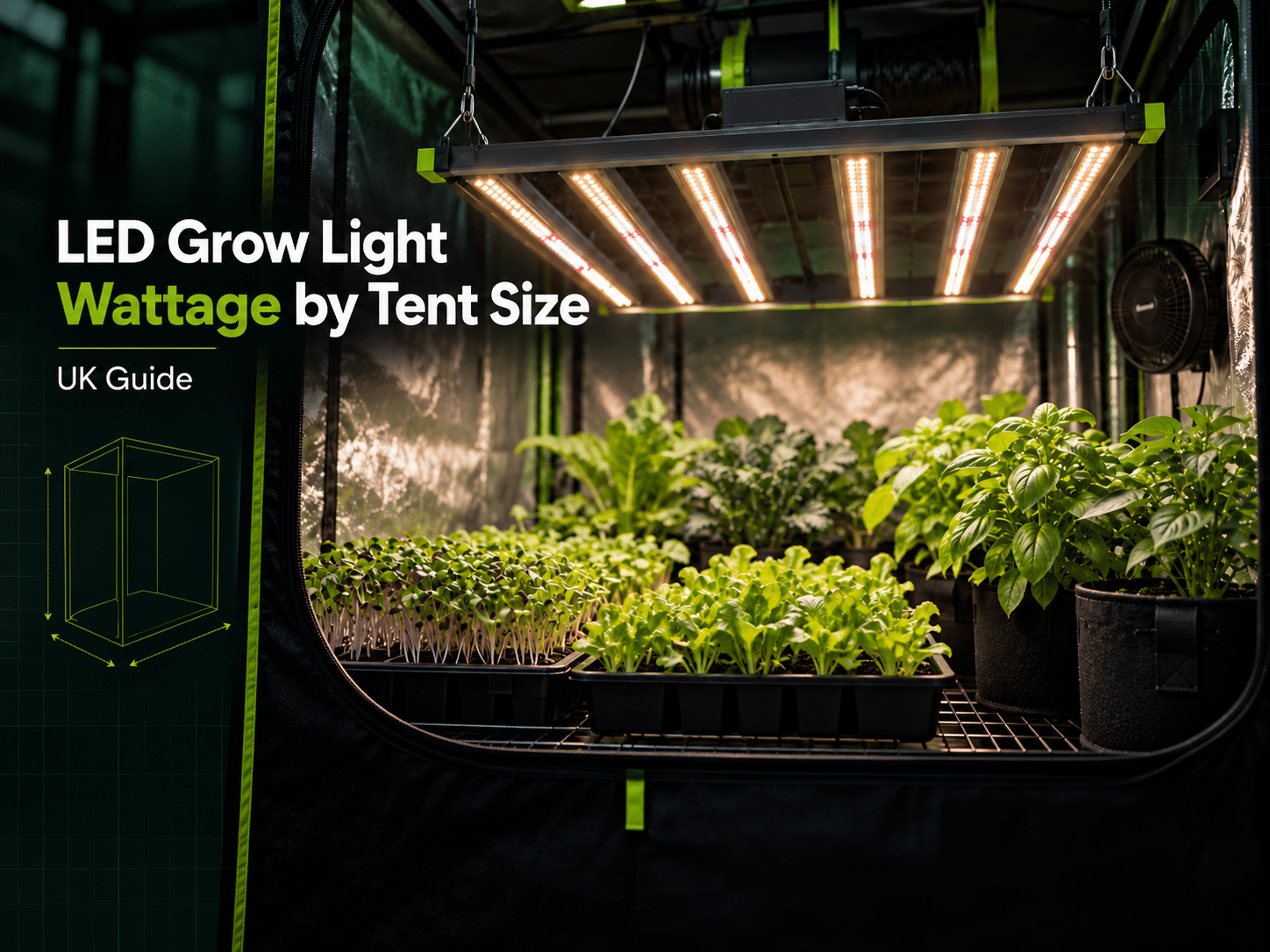
LED Grow Light Wattage by Grow Tent Size: UK Guide 2026

Estimated Reading Time: 13 minutes

Choosing the right LED grow light for a grow tent in 2026 is not simply a case of buying the highest wattage you can afford. Modern horticultural LEDs vary considerably in efficiency, PPF, PPFD distribution and coverage, so two fixtures drawing the same wattage can perform very differently.
As a practical starting point, modern efficient LED grow lights can be sized according to the floor area of the grow tent. For higher-light and flowering stages, approximately 300–500 watts per square metre provides a useful planning range, while vegetative growth generally requires considerably less.
Wattage is only part of the story, though. PPF, PPFD, efficiency, fixture coverage, hanging height and dimming all affect how well an LED performs in a particular space.
In this guide, we’ll show you how many watts of LED lighting common grow tent sizes typically need, explain how to calculate the requirement yourself and help you choose from our range of LED grow lights.
Key Takeaways
- Start by calculating the floor area of your grow tent in square metres.
- For modern efficient LEDs, around 300–500W per m² is a useful planning range for high-light or flowering stages.
- Vegetative growth normally requires significantly less intensity, so a dimmable LED can often be used throughout the full growing cycle.
- A 1.2m × 1.2m tent has 1.44m² of floor area, giving a high-light starting range of approximately 430–720W.
- A 1.5m × 1.5m tent has 2.25m² of floor area, giving a starting range of approximately 675–1,125W.
- Do not judge an LED by watts alone. Check the fixture’s PPF, efficiency in µmol/J, coverage area and PPFD distribution.
- High-output fixtures such as the Gorilla 720W LED, Omega 720W Plus and LUMii BLACK² 720/960 LED are designed for larger grow-tent footprints.
- Powerful lighting also produces heat, so make sure your ventilation system is correctly sized.
- If you want to understand colour and spectrum as well as intensity, read our guide to choosing the right LED light spectrum.
Recommended Products

-16%
Gorilla 720W LED Grow Light UK | Full Spectrum Dimmable LED
Original price was: £130.00.£109.50Current price is: £109.50. incl. Vat
Gorilla 720W LED Grow Light is a high-performance full spectrum LED designed for indoor growing, grow tents, and hydroponic systems. With powerful output, efficient coverage, and a dimmable 6-bar design, it is ideal for growers looking to maximise yields and plant health.
- ✔ Full spectrum LED for veg and flowering stages
- ✔ Covers up to 1.5m x 1.5m grow areas
- ✔ High output (approx. 1944 µmol/s)
- ✔ Dimmable with 0–10V or onboard control
- ✔ Foldable 6-bar design with built-in driver

-15%
Omega 720W Plus LED Grow Light | Full Spectrum 6-Bar LED Fixture
Original price was: £199.00.£169.99Current price is: £169.99. incl. Vat
The Omega 720W Plus LED is a powerful full spectrum LED grow light designed for serious indoor growers who want high output, excellent efficiency and simple installation. With 2088 µmol/s PPF, 2.9 µmol/J efficacy, a built-in driver and a foldable 6-bar design, it delivers strong, even light coverage for vegetative growth and flowering.
- ✔ High-output 720W full spectrum LED grow light
- ✔ 2088 µmol/s PPF for strong plant growth and flowering
- ✔ 2.9 µmol/J efficacy for efficient light output
- ✔ Built-in driver with no external ballast required
- ✔ Foldable 6-bar design for easy setup and storage
- ✔ 0–10V dimming and RJ11 daisy chain control

1x ballast2x ballastfixture no ballast
LUMii BLACK² 720/960 LED Grow Light | Full Spectrum Modular LED
Price range: £220.00 through £260.00 incl. Vat
The LUMii BLACK² 720/960 LED is a high-output, full spectrum LED grow light designed for serious indoor growers who want powerful performance, flexible coverage and excellent efficiency. With a modular 6-bar design, up to 2596 µmol/s PPF output and the option to run from one or two LUMii BLACK ballasts, it is ideal for growers upgrading from traditional HPS lighting to a more efficient LED setup.
- ✔ High-output full spectrum LED grow light
- ✔ Runs at 720W with one ballast or up to 960W with two ballasts
- ✔ Maximum PPF output of up to 2596 µmol/s
- ✔ Modular 6-bar fixture can also be used as two separate 3-bar lights
- ✔ Ideal coverage for a 1.5m x 1.5m grow area
- ✔ Excellent upgrade from 600W or 1000W HPS grow lighting
Quick Answer: How Many Watts of LED Grow Light Do I Need?
For a modern, efficient LED grow light, a useful starting point is to calculate the floor area of the grow tent and then multiply it by the amount of LED wattage required per square metre.
As a general planning guide:
- Seedlings and propagation: much lower light levels are normally required.
- Vegetative growth: approximately 150–250W per m² can provide a useful starting range.
- Higher-light and flowering stages: approximately 300–500W per m² is a useful planning range with an efficient modern LED.
These figures are not universal targets for every plant. Different species, growth stages and cultivation methods require different light intensities. They should be used to narrow down the correct fixture size before checking the manufacturer’s coverage and PPFD information.
The simple calculation is:
Grow tent length × grow tent width = floor area in m²
Then:
Floor area × 300–500W = approximate higher-light LED wattage range
For example, a 1.2m × 1.2m grow tent has a floor area of:
1.2 × 1.2 = 1.44m²
1.44 × 300W = 432W
1.44 × 500W = 720W
That gives a practical higher-light range of approximately 430–720W of efficient LED lighting.
LED Grow Light Wattage by Grow Tent Size
The table below provides a quick starting point for some of the most common UK grow tent sizes.
| Grow Tent Size | Floor Area | Vegetative LED Range | Higher-Light / Flowering LED Range | Typical Setup |
|---|---|---|---|---|
| 60 × 60cm | 0.36m² | 55–90W | 110–180W | Compact LED |
| 80 × 80cm | 0.64m² | 95–160W | 190–320W | 200–300W LED |
| 100 × 100cm | 1.00m² | 150–250W | 300–500W | 300–500W LED |
| 120 × 120cm | 1.44m² | 215–360W | 430–720W | 480–720W LED |
| 150 × 150cm | 2.25m² | 340–560W | 675–1,125W | 720–1000W LED |
| 120 × 240cm | 2.88m² | 430–720W | 865–1,440W | 2 × suitable fixtures |
| 200 × 200cm | 4.00m² | 600–1,000W | 1,200–2,000W | Multiple LED fixtures |
| 240 × 240cm | 5.76m² | 865–1,440W | 1,730–2,880W | Typically 4 × high-output fixtures |
Important: these figures assume reasonably efficient modern horticultural LEDs. Older or lower-efficiency fixtures may require more electricity to deliver the same usable light.
Always check the manufacturer’s recommended coverage area and, where available, the fixture’s PPFD map before choosing a light.
Why Watts Alone Do Not Tell You How Good a Grow Light Is
Wattage tells you how much electrical power a grow light consumes. It does not tell you directly how much useful light reaches your plants.
This is one of the most important differences between comparing modern LED grow lights and older lighting systems.
When comparing fixtures, look at:
- Wattage – electrical power consumed by the fixture.
- PPF – the total amount of photosynthetically useful light produced by the fixture, normally measured in µmol/s.
- Efficiency or efficacy – the amount of useful light produced per watt of electricity, expressed in µmol/J.
- PPFD – the amount of photosynthetically active light reaching a particular area of canopy, expressed in µmol/m²/s.
- Coverage – how evenly the fixture distributes light across your grow area.
A highly efficient 720W LED can therefore produce considerably more usable plant light than another 720W fixture with lower efficiency.
What Are PPF and PPFD?
PPF – Total Light Output
Photosynthetic Photon Flux (PPF) measures the total number of photosynthetically active photons a fixture produces each second.
PPF is expressed in µmol/s.
For example, the Omega 720W Plus LED produces approximately 2088 µmol/s from 720W of electrical power.
This gives it an efficacy of approximately 2.9 µmol/J.
PPFD – Light Reaching the Canopy
Photosynthetic Photon Flux Density (PPFD) measures how much of that light actually lands on a square metre of growing area each second.
This is why fixture design and coverage matter.
A light could produce a high PPF figure but still create poor results if most of that output is concentrated in the centre of the canopy or lost outside the grow space.
Bar-style LEDs have become popular partly because they can spread the light over a wider area and provide more even canopy coverage.
What Is LED Grow Light Efficiency?
LED efficiency is normally expressed as µmol/J.
The higher the figure, the more photosynthetic light the fixture produces from each watt of electricity consumed.
For example:
- A 720W LED operating at 2.0 µmol/J would produce around 1,440 µmol/s.
- A 720W LED operating at 2.7 µmol/J would produce around 1,944 µmol/s.
- A 720W LED operating at 2.9 µmol/J would produce around 2,088 µmol/s.
All three lights consume the same nominal 720 watts, but the more efficient fixture produces considerably more usable light.
This is why we recommend comparing wattage, PPF and efficacy together rather than choosing a fixture from wattage alone.
What Size LED Grow Light for a 60 × 60cm Tent?
A 60 × 60cm grow tent has a floor area of:
0.6 × 0.6 = 0.36m²
For higher-light growth:
0.36 × 300–500W = approximately 108–180W
A compact LED in roughly the 100–180W range is therefore a sensible starting point for many full-cycle applications.
Propagation and young plants require considerably less light. For seedlings, cuttings and early growth, see our range of propagation lighting.
What Size LED Grow Light for an 80 × 80cm Tent?
An 80 × 80cm tent provides:
0.8 × 0.8 = 0.64m²
At 300–500W per m²:
approximately 190–320W
For this size, an efficient LED of around 200–300W is a useful starting point, depending on the plant, growth stage and fixture efficiency.
What Size LED Grow Light for a 1m × 1m Tent?
A 1m × 1m tent has exactly 1m² of growing area, which makes the calculation particularly simple.
For high-light growth:
approximately 300–500W of modern efficient LED lighting
The lower end of this range can provide efficient coverage, while growers requiring greater intensity can move towards the upper end provided temperature, hanging height and plant requirements are managed correctly.
What Size LED Grow Light for a 1.2m × 1.2m Tent?
A 1.2m × 1.2m grow tent contains 1.44m² of canopy area.
The basic calculation gives:
approximately 430–720W
This is one of the most common sizes for high-output LED fixtures.
A 720W fixture provides:
720 ÷ 1.44 = 500W per m²
That places a 720W LED at the upper end of the practical range for this tent size.
This makes dimming particularly useful. A dimmable 720W LED can be operated at a lower output during early growth and increased as the plants develop.
Current Acorn options include:
- Gorilla 720W LED – approximately 1944 µmol/s PPF with a dimmable 6-bar design.
- Omega 720W Plus LED – 2088 µmol/s PPF and approximately 2.9 µmol/J efficacy.
- AU LED 720W – full-spectrum fixture designed for approximately 1.2–1.5m grow spaces.
- Omega Black 720W LED – full-spectrum bar-style fixture suitable for approximately 1.2–1.5m spaces.
What Size LED Grow Light for a 1.5m × 1.5m Tent?
A 1.5m × 1.5m grow tent provides:
1.5 × 1.5 = 2.25m²
Using the 300–500W per m² range gives:
approximately 675–1,125W
A 720W fixture provides:
720 ÷ 2.25 = 320W per m²
That places a good 720W LED near the lower end of the higher-light range, while a fixture operating around 900–1000W provides considerably more intensity.
The LUMii BLACK² 720/960 LED is particularly interesting for this tent size because the fixture can operate at 720W or, with two compatible ballasts, up to approximately 960W.
At maximum output it produces up to 2596 µmol/s PPF, and the fixture is specifically designed around a 1.5m × 1.5m growing area.
The Gorilla 720W LED, Omega 720W Plus and Omega Black 720W are also designed to cover spaces up to approximately 1.5m × 1.5m.
What Size LED Grow Light for a 1.2m × 2.4m Tent?
A 1.2m × 2.4m grow tent has a floor area of:
1.2 × 2.4 = 2.88m²
At 300–500W per m²:
approximately 865–1,440W
This is normally better covered using two fixtures rather than one very powerful central light.
For example:
2 × 720W = 1,440W total
This gives each fixture approximately a 1.2m × 1.2m area to illuminate and provides a more even spread across the full rectangular canopy.
Using multiple fixtures also provides more flexibility when adjusting hanging height or dimming individual sections.
What Size LED Grow Light for a 2.4m × 2.4m Tent?
A 2.4m × 2.4m tent contains:
5.76m² of floor area
At 300–500W per m²:
approximately 1,730–2,880W
Rather than attempting to cover this with one fixture, a multi-light layout will normally provide much better uniformity.
Four 720W LEDs provide:
4 × 720W = 2,880W
Each light can then cover an individual 1.2m × 1.2m section of the larger tent.
For larger multi-light installations, also consider your electrical load, lighting controls and environmental requirements. Browse our timers and contactors for suitable lighting-control equipment.
Why Dimmable LED Grow Lights Are So Useful
A plant does not normally need maximum light intensity from the moment it emerges.
Dimming allows one correctly sized fixture to be used through different stages of plant development without replacing the light.
For example, a powerful 720W LED might be operated at a much lower percentage during earlier growth before being gradually increased as canopy size and light demand rise.
Dimming can help:
- Reduce unnecessary electricity use
- Reduce heat output
- Prevent excessive light intensity over young plants
- Allow one fixture to serve several growth stages
- Fine-tune PPFD without constantly changing hanging height
When comparing LEDs, check whether dimming is built into the fixture or requires a separate controller.
Does Fixture Shape Matter as Much as Wattage?
Yes.
Grow light wattage tells you how much power the fixture consumes, but the physical design determines how that output is distributed.
A compact fixture can create very intense light directly below the centre while leaving weaker areas around the edge.
Multi-bar LED fixtures spread diodes across a much larger physical area, helping create a more even PPFD distribution across a grow tent canopy.
This is particularly useful in 1.2m and 1.5m tents where even edge-to-edge coverage is important.
What Is a PPFD Map?
A PPFD map shows measurements taken at multiple points underneath a grow light.
It normally displays:
- Centre intensity
- Corner intensity
- Edge intensity
- The size of the measured area
- The hanging height used during testing
A useful PPFD map tells you far more about real coverage than a single maximum reading.
When comparing two lights, look for good uniformity rather than simply choosing the fixture with the highest centre number.
What Is DLI and Why Does It Matter?
Daily Light Integral (DLI) measures the total amount of photosynthetically active light received over an entire day.
This is important because light intensity and lighting duration work together.
A moderate PPFD delivered for a longer period can produce a similar daily total to stronger light delivered for fewer hours.
The basic calculation under constant electric lighting is:
DLI = PPFD × hours of light × 0.0036
For example:
A PPFD of 600 µmol/m²/s for 12 hours gives:
600 × 12 × 0.0036 = 25.92 mol/m²/day
For a more detailed explanation of PPFD and DLI calculations, see Apogee Instruments’ PPFD-to-DLI guide.
Do I Need a PAR Meter?
You do not need a PAR meter simply to install an LED grow light, but it is one of the most useful tools for growers who want to measure their lighting rather than guess.
A suitable full-spectrum quantum meter can measure PPFD at canopy level.
Take measurements:
- Directly under the centre of the fixture
- At several points between the centre and edges
- Near each corner of the canopy
You can then adjust the hanging height, dimmer setting or fixture layout to improve uniformity.
For LED lighting, make sure the measuring device is designed to accurately measure LED spectra rather than relying on a standard lux meter intended for human vision.
How High Should an LED Grow Light Be Above the Plants?
There is no universal hanging height for every LED grow light.
The correct distance depends on:
- Fixture wattage
- PPF output
- Optics and fixture design
- Growth stage
- Dimmer setting
- Grow tent dimensions
Always start with the manufacturer’s recommended hanging height where available.
If you have a PAR meter, measure PPFD at canopy level and adjust the light gradually rather than relying entirely on distance.
We will cover this in more depth in our dedicated LED hanging height and PPFD guide.
Can an LED Grow Light Be Too Powerful for a Grow Tent?
Yes.
More wattage is not automatically better.
An oversized fixture can:
- Waste electricity
- Create unnecessary heat
- Produce excessive light intensity
- Be physically too large for the tent
- Force the fixture to be mounted too close to the canopy
For example, a 1000W LED running at full power in a 1m × 1m tent would provide around 1000W per m², far above the basic planning range discussed in this guide.
If using an oversized fixture, it should only be considered where the physical dimensions fit safely and the unit can be dimmed sufficiently.
LED Grow Lights vs HPS: Is Wattage Comparable?
A 600W LED and a 600W HPS lamp both consume approximately 600 watts, but that does not mean they deliver the same amount of usable light to the canopy.
Modern LEDs can convert electricity into photosynthetically useful light more efficiently and can distribute that output across the canopy more evenly.
This means a grower replacing an older HPS system should compare:
- Total PPF
- Fixture efficiency
- PPFD distribution
- Coverage area
- Electrical consumption
- Heat load
rather than simply replacing a 600W HPS with any product labelled “600W LED”.
If you want a broader introduction to indoor lighting technologies, read our in-depth guide to indoor grow lighting.
How Does Grow Light Wattage Affect Heat and Ventilation?
LED lighting is more efficient than older HID technology, but the electricity consumed by the fixture still ultimately contributes heat to the growing environment.
A higher-powered light therefore normally increases the amount of heat your ventilation system must manage.
When upgrading from a smaller fixture to a powerful 720W, 960W or multi-light system, make sure your extraction is capable of maintaining suitable temperature and humidity.
Use our grow tent extractor fan and carbon filter sizing guide to calculate the ventilation requirement for your space.
Lighting Small Plants, Seedlings and Cuttings
Seedlings and freshly propagated plants do not normally require the same light intensity as a mature canopy.
Using a high-output 720W fixture at full power above a propagation tray would be unnecessary.
For these early stages, purpose-built propagation LEDs provide a more suitable low-power option.
Acorn’s current propagation lighting includes low-wattage LED bars and strips designed specifically for seedlings, cuttings and early vegetative development.
Choosing an LED Grow Light: What to Check Before Buying
Before choosing a fixture, check the following:
- Grow tent dimensions – make sure the physical fixture and advertised coverage fit your space.
- Actual power draw – use true input wattage rather than misleading model names.
- PPF – compare total photosynthetic output.
- Efficiency – compare µmol/J where available.
- PPFD map – look for even coverage across the intended footprint.
- Dimming – valuable when using one fixture across several stages.
- Physical dimensions – especially important with large bar-style fixtures.
- Hanging clearance – allow room for the light, hangers, plant height and safe separation.
- Heat and extraction – higher electrical loads require appropriate climate control.
- Controls – consider timers and controllers for consistent lighting schedules.
Browse our complete LED grow light range or our wider grow lights section.
Useful LED Grow Lights Available from Acorn Horticulture
Gorilla 720W LED
The Gorilla 720W LED Grow Light is a dimmable six-bar full-spectrum fixture producing approximately 1944 µmol/s PPF and designed to cover areas up to approximately 1.5m × 1.5m.
Omega 720W Plus LED
The Omega 720W Plus LED produces approximately 2088 µmol/s at 2.9 µmol/J, with a built-in driver, six-bar design and 0–10V dimming.
AU 720W LED
The AU LED 720W Grow Light is a full-spectrum fixture with a built-in driver designed for approximately 1.2m–1.5m growing spaces.
Omega Black 720W LED
The Omega Black 720W LED provides a full-spectrum bar-style lighting solution for approximately 1.2m–1.5m spaces.
LUMii BLACK² 720/960 LED
The LUMii BLACK² 720/960 LED provides a more flexible high-output option. It can operate from a single ballast or use two compatible ballasts to reach up to approximately 960W and 2596 µmol/s PPF.
Its full six-bar configuration is particularly well suited to a 1.5m × 1.5m growing area.
Related Grow Lighting Guides
For more information about choosing and using indoor grow lights, read:
- Understanding Light Spectrum: Choosing the Right LEDs for Your Plants
- Grow Lighting Mastery: In-Depth Guide for Indoor Plants
- Smart Grow Lighting: Automation and Control for Maximum Efficiency
- How to Build a Safe & Efficient Indoor Grow Room
- What Size Extractor Fan & Carbon Filter Do I Need?
Frequently Asked Questions
How many watts of LED grow light do I need per square metre?
For a modern efficient horticultural LED, approximately 300–500W per square metre provides a useful planning range for higher-light growth and flowering. Vegetative growth normally requires less, often around 150–250W per square metre. Always check the actual fixture efficiency, coverage and plant requirements.
What size LED grow light do I need for a 1.2m × 1.2m tent?
A 1.2m × 1.2m tent has 1.44m² of floor area. Using 300–500W per m² gives an approximate higher-light range of 430–720W. A dimmable 720W LED is therefore a popular high-output option for this tent size.
Is 720W too much for a 1.2m grow tent?
720W equals approximately 500W per m² in a 1.2m × 1.2m tent, placing it at the upper end of the planning range used in this guide. A dimmable fixture gives you the flexibility to reduce intensity when full output is not required.
Is 720W enough for a 1.5m × 1.5m grow tent?
A 720W LED provides approximately 320W per m² across a 1.5m × 1.5m footprint, putting it towards the lower end of the higher-light range. A high-efficiency 720W fixture may provide suitable coverage, while growers wanting greater intensity can consider higher-output fixtures such as a 900–1000W system.
How many LED grow lights do I need for a 1.2m × 2.4m tent?
A 1.2m × 2.4m tent contains 2.88m². Two suitable fixtures are normally preferable to one central light because they provide more even coverage. Two 720W fixtures provide a total of 1,440W, or 500W per m².
Is a higher wattage grow light always better?
No. An oversized fixture can waste electricity, increase heat and provide excessive intensity. The correct choice is a fixture that matches the grow area and provides suitable PPFD across the full canopy.
What is more important: watts or PPFD?
Watts tell you how much electricity a grow light consumes. PPFD describes the amount of photosynthetically useful light reaching the canopy. Both are useful, but PPFD and coverage provide a better picture of how the plants are actually being illuminated.
What does µmol/J mean on an LED grow light?
µmol/J measures fixture efficacy — how much photosynthetic light is produced for each joule of electrical energy. A higher figure indicates that more usable light is being produced from the same amount of electricity.
Can I use a 720W LED throughout the entire growing cycle?
Yes, provided the fixture is suitable for the space and can be dimmed appropriately. Young plants generally require much less light than a mature canopy, so reducing output during earlier stages can save electricity and prevent excessive intensity.
Do LED grow lights still need ventilation?
Yes. LEDs usually create less unwanted heat than older HID systems for the same useful light output, but a high-powered LED still consumes electricity and produces heat. Extraction and air circulation remain important for controlling temperature and humidity.
How can I measure whether my LED is providing enough light?
A suitable full-spectrum PAR or quantum meter can measure PPFD at canopy level. Take readings at several points across the growing area and compare them with the requirements of the plants you are growing.
Need Help Choosing the Right LED for Your Grow Tent?
If you are unsure which LED fixture best suits your tent, contact Acorn Horticulture and tell us the dimensions of your grow space, the plants you are growing and your existing ventilation setup.
Browse our LED Grow Lights, Grow Tents and Grow Light Hangers & Accessories to build your complete lighting setup.