What Size Grow Tent Do I Need? UK Grow Tent Size Guide 2026

Estimated Reading Time: 13 minutes

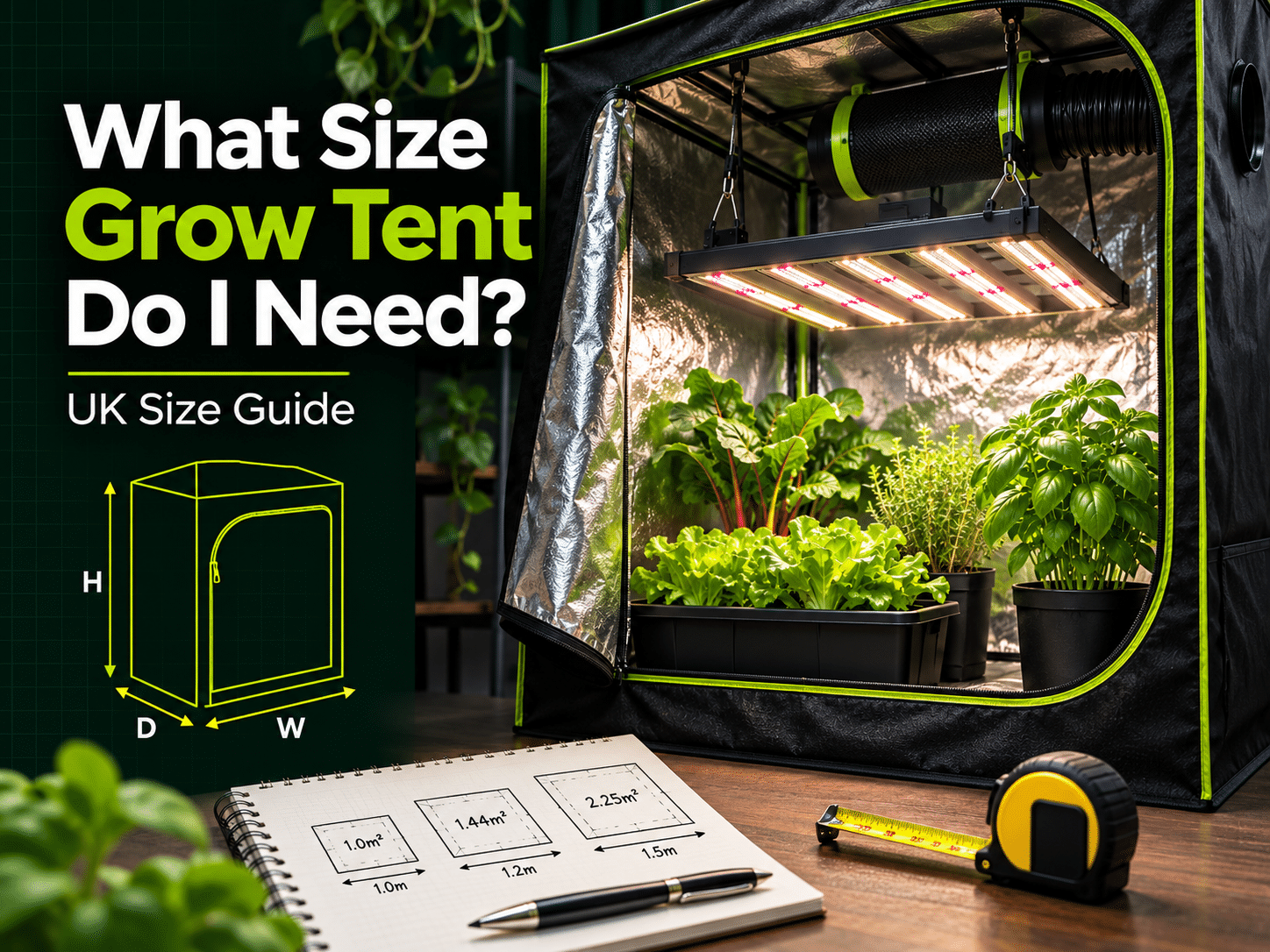
What size grow tent do you need? The best way to choose is to start with the space available in your room, then work backwards from the mature plant canopy, lighting coverage, equipment footprint and usable height.
For many home indoor-growing setups, 1m × 1m and 1.2m × 1.2m grow tents provide a practical balance between usable growing area, lighting requirements and environmental control. Smaller 60–80cm tents are useful for propagation, herbs and compact setups, while 1.5m, 2m and larger tents require substantially more lighting, ventilation and space around the tent.
Don’t choose a tent from plant count alone. Four compact plants can require far less room than four large mature plants, while hydroponic systems, reservoirs, fans and filters can take up valuable space before any plants are added.
In this guide we’ll compare common UK grow tent sizes from compact propagation tents through to 3m × 3m setups and show you how to match the tent to your available room, lighting and ventilation.
You can also browse our current range of grow tents, or if you already know your tent size, use our LED Grow Light Wattage by Grow Tent Size Guide to choose the lighting.
Key Takeaways
- Measure your room before buying the tent — including ceiling height, doors, skirting boards and space needed to open the tent.
- Choose the tent around the mature canopy and equipment footprint, not plant count alone.
- A 1m × 1m × 2m tent is a practical compact full-height setup with 1m² of floor area.
- A 1.2m × 1.2m tent provides 1.44m² and is one of the most common sizes for a single high-output LED.
- A 1.5m × 1.5m tent provides 2.25m² and needs considerably more lighting and airflow than a 1.2m tent.
- Rectangular tents such as 1.2m × 2.4m are usually better served by two lighting fixtures rather than one central light.
- Don’t forget vertical space for pots or hydroponic systems, the plant canopy, LED hanging distance, the light itself and any filter or ducting above it.
- A larger tent normally means higher costs for lighting, extraction and electricity.
- Leave enough room to reach plants, reservoirs, fans and other equipment for maintenance.
- Once you’ve chosen the tent, correctly size the extractor fan and carbon filter and match the LED wattage to the tent floor area.
Recommended Grow Tents


Probox Propagation Tent (S, M, L & XL Seed & Cutting Tent)
Price range: £49.99 through £229.00 incl. Vat
The Probox Propagation Tent is designed for germinating seeds and rooting cuttings in a controlled growing environment. With a highly reflective interior, strong frame, and multiple size options, it is an ideal propagation tent for growers who want reliable early-stage plant development.
- ✔ Ideal for seeds, cuttings, and clones
- ✔ Highly reflective mylar interior
- ✔ Strong steel frame with durable 420D fabric
- ✔ Available in S, M, L, and XL sizes


LightHouse LITE Grow Tent 100 x 100 x 200cm
£95.00 incl. Vat
The LightHouse LITE Grow Tent 100 x 100 x 200cm is a practical budget grow tent designed for growers who want a straightforward, lightweight and reliable indoor growing space without unnecessary extras.
- ✔ Compact 1m² grow tent footprint with 200cm height
- ✔ Lightweight frame built from 16mm steel poles with nylon corners
- ✔ Tri-Layer 210 Denier fabric with UltraLux reflective liner
- ✔ Multiple ducting and cable gland entry points with double seals
- ✔ Roof extraction sock and inline socks for use with air-cooled lighting
- ✔ Low-level passive air vents with fine anti-mite mesh and light-proof covers
- ✔ Suitable for a single lamp set-up and can also be used as a drying or storage environment
Quick Answer: What Size Grow Tent Should I Buy?
The right grow tent should comfortably fit:
- your mature plant canopy
- pots or hydroponic system
- grow light and hanging equipment
- extractor fan, carbon filter and ducting
- circulation fans
- reservoirs or other equipment
- enough access for watering, inspection and maintenance
As a practical starting point:
| Grow Tent Size | Floor Area | Typical Use | Higher-Light LED Starting Range |
|---|---|---|---|
| 60 × 60cm | 0.36m² | Propagation, herbs, compact setup | 110–180W |
| 80 × 80cm | 0.64m² | Small home grow | 190–320W |
| 100 × 100cm | 1.00m² | Compact full-height setup | 300–500W |
| 120 × 120cm | 1.44m² | Popular single-light setup | 430–720W |
| 150 × 150cm | 2.25m² | Larger single-fixture or multi-light setup | 675–1,125W |
| 120 × 240cm | 2.88m² | Rectangular two-light setup | 865–1,440W |
| 200 × 200cm | 4.00m² | Large multi-light grow | 1,200–2,000W |
| 240 × 240cm | 5.76m² | Large multi-light room | 1,730–2,880W |
| 300 × 300cm | 9.00m² | Dedicated large grow room | Multiple fixtures required |
Important: the lighting figures are broad planning ranges for efficient modern horticultural LEDs during higher-light stages. They are not universal recommendations for every plant species.
For full calculations and lower-intensity vegetative ranges, see our LED Grow Light Wattage by Grow Tent Size Guide.
Start by Measuring the Room
Before deciding how many plants you want to grow, measure the physical space where the tent will actually be installed.
Measure:
- available width
- available depth
- floor-to-ceiling height
- doorways the packed tent must pass through
- skirting boards and radiators
- sloping ceilings
- shelves or cupboards
- electrical sockets
- the route your extraction ducting will take
Don’t assume that a 1.2m wide space means a 1.2m tent will fit comfortably.
You still need enough clearance around the tent to open doors and zips, connect ducting and reach equipment.
If space allows, leaving approximately 20–30cm around accessible sides can make installation and maintenance considerably easier.
Floor Size Is Only Half the Story
Most people focus on the width and depth of a grow tent, but height can be just as important.
A 2m-high tent does not give you 2m of usable plant height.
You must allow space for:
- pots or hydroponic system
- plant canopy
- space between the canopy and grow light
- the physical depth of the LED fixture
- rope ratchets or other hangers
- carbon filter or ducting if mounted overhead
For example, if the pot or hydroponic system uses 30cm of height, the light and hangers use 15cm and you require 40cm between the LED and canopy, approximately 85cm of the tent height has already been used before considering plant height.
That is why full-height tents around 2m are often easier to manage than very short tents when using powerful grow lights.
Choose by Canopy Size, Not Just Plant Count
There is no universal answer to questions such as “How many plants fit in a 1.2m tent?”
Plant size varies enormously.
A tray of seedlings, several compact herbs and a mature tomato plant can all have completely different space requirements.
The better question is:
How much mature canopy area do I need?
Think about:
- the mature width of the plants
- container diameter
- spacing between containers
- air movement around leaves
- whether you need to walk or reach between plants
- the dimensions of the hydroponic system
A tent packed completely from wall to wall may technically hold more pots, but it can become difficult to water, inspect and maintain.
How Many Plants Fit in a Grow Tent?
Plant count should only be used as a rough planning guide because crop type, pot size and training method can completely change the answer.
For medium-sized container-grown plants, a broad starting point might look like this:
| Grow Tent | Broad Medium-Plant Starting Point | Better Planning Measure |
|---|---|---|
| 60 × 60cm | 1–2 | 0.36m² mature canopy |
| 80 × 80cm | 1–4 | 0.64m² mature canopy |
| 100 × 100cm | 2–4 | 1.00m² mature canopy |
| 120 × 120cm | 4–6 | 1.44m² mature canopy |
| 150 × 150cm | 4–9 | 2.25m² mature canopy |
| 120 × 240cm | 8–12 | 2.88m² mature canopy |
These are deliberately broad estimates rather than fixed capacities.
Fewer large plants can fill the same canopy as many small plants, so always plan around the final occupied area.
What Size Grow Tent for One Plant?
For one compact plant, herb or small horticultural project, a 60 × 60cm tent can be sufficient.
It provides 0.36m² of floor area while keeping lighting and ventilation requirements relatively low.
If the plant is expected to become considerably larger, an 80 × 80cm or 1m × 1m tent provides more room for canopy development, equipment and airflow.
Don’t buy the smallest possible tent simply because you’re growing one plant. Its mature size matters more than the number one.
What Size Grow Tent for Two Plants?
Two compact or medium-sized plants can often work in a 60 × 60cm to 80 × 80cm tent, depending on their mature spread.
If you want more room around them or expect a larger canopy, a 1m × 1m tent is more forgiving.
The extra space can also make it easier to position a circulation fan, watering equipment and containers without crowding the canopy.
What Size Grow Tent for Four Plants?
For four medium-sized container plants, a 1m × 1m or 1.2m × 1.2m tent is a common starting point.
The 1m tent provides 1m² of floor area, while a 1.2m × 1.2m tent provides 1.44m² — around 44% more floor space.
This can make a substantial difference once pots, circulation fans and other equipment are installed.
What Size Grow Tent for Six Plants?
Six medium-sized plants often fit more comfortably in a 1.2m × 1.2m to 1.5m × 1.5m tent, but again, mature canopy size matters more than the number of containers.
If the plants will become large, moving up a tent size can provide much better access and airflow.
What Size Grow Tent for Eight or More Plants?
Once you’re planning eight or more established plants, rectangular or larger square tents become more practical.
Common options include:
- 1.2m × 2.4m
- 2m × 2m
- 2.4m × 2.4m
- 3m × 3m
At these sizes you’re no longer simply choosing a larger tent. You’re designing a multi-light indoor growing environment.
You need to plan:
- multiple lighting fixtures
- electrical load
- larger extraction systems
- air circulation
- access routes
- irrigation or reservoir placement
- temperature and humidity control
What Size Grow Tent Is Best for Beginners?
For many beginners with enough room, a 1m × 1m × 2m grow tent is a practical starting size.
It has several advantages:
- exactly 1m² of floor area makes lighting calculations simple
- 2m height provides useful vertical clearance
- it can support a meaningful canopy without becoming a large-room project
- lighting and extraction requirements remain manageable
- you can normally reach most of the growing area from the front
Acorn’s LightHouse LITE 100 × 100 × 200cm provides this exact 1m² footprint and 2m height.
If you need something only for seeds and cuttings, a dedicated Probox Propagation Tent may be far more appropriate than a full-height tent.
What Size Grow Tent Is 2×2 Feet?
Grow tents are sometimes described using imperial measurements, particularly in overseas guides.
Useful approximate conversions include:
| Imperial Size | Approximate Metric Equivalent |
|---|---|
| 2 × 2 ft | 60 × 60cm |
| 2.5 × 2.5 ft | 75–80 × 75–80cm |
| 3 × 3 ft | 90 × 90cm |
| 4 × 4 ft | 120 × 120cm |
| 5 × 5 ft | 150 × 150cm |
| 4 × 8 ft | 120 × 240cm |
| 8 × 8 ft | 240 × 240cm |
| 10 × 10 ft | 300 × 300cm |
The exact dimensions vary slightly between manufacturers, so always check the actual metric dimensions before ordering.
What Size Grow Tent for a 300W LED?
Using the broad higher-light planning range of approximately 300–500W per square metre, a 300W efficient LED is well matched to roughly 0.6–1m² depending on the fixture’s efficiency, PPFD distribution and the plants being grown.
That makes common tent sizes such as 80 × 80cm or 1m × 1m sensible places to begin checking manufacturer coverage.
Always confirm the actual LED’s recommended footprint rather than choosing the tent from wattage alone.
What Size Grow Tent for a 600W Light?
A 600W efficient modern LED can potentially cover around 1.2m × 1.2m for higher-light growing, depending on fixture efficiency and PPFD distribution.
A traditional 600W HPS setup has also commonly been paired with tents around this footprint.
However, LED and HPS wattage should not automatically be treated as equivalent because modern LED fixtures can differ significantly in efficacy and light distribution.
What Size Grow Tent for a 720W LED?
A 720W LED is commonly associated with 1.2m × 1.2m and 1.5m × 1.5m grow spaces, depending on the fixture and required intensity.
In a 1.2m × 1.2m tent:
720W ÷ 1.44m² = 500W/m²
This places a 720W LED at the upper end of the higher-light planning range used in our lighting guide.
In a 1.5m × 1.5m tent:
720W ÷ 2.25m² = 320W/m²
This gives a lower average wattage per square metre but a larger footprint.
Which is better depends on the actual fixture’s PPF, PPFD map and manufacturer coverage recommendation.
Read our full LED wattage guide before matching a high-output fixture to your tent.
Match the Tent to the Light’s Coverage
A grow tent and grow light should be chosen as a matched system.
Buying a large tent and installing a small light creates poorly illuminated edges.
Buying a powerful oversized light for a small tent can create excessive intensity, unnecessary heat and higher electricity costs.
Check:
- recommended coverage area
- fixture dimensions
- PPF
- PPFD map
- efficacy
- dimming range
- recommended hanging height
If you’re comparing electricity consumption as well as performance, read our UK Grow Light Running Cost Guide.
Don’t Forget LED Hanging Distance
The light itself needs vertical clearance above the canopy.
A powerful LED cannot simply be pushed against the tent roof and placed immediately above the plants.
The required distance varies between fixtures and plant stages, so always follow the manufacturer’s recommendations and use PPFD measurements where possible.
This is another reason why very short tents can become restrictive when powerful lighting is used.
How Much Ventilation Does a Grow Tent Need?
As the grow tent gets larger, its air volume increases and the extraction system must move more air.
The tent volume is calculated as:
Length × width × height = volume in cubic metres
For example, a 1.2m × 1.2m × 2m tent has a volume of:
1.2 × 1.2 × 2 = 2.88m³
A 2m × 2m × 2m tent contains:
2 × 2 × 2 = 8m³
So moving from a 1.2m square tent to a 2m square tent creates almost three times as much air volume to manage.
Our Extractor Fan & Carbon Filter Sizing Guide explains how to calculate the required airflow and account for filters and ducting.
Leave Space for a Carbon Filter and Ducting
A common mistake is planning the plant and lighting space perfectly, then discovering there isn’t enough room for the ventilation equipment.
If your carbon filter is mounted inside the top of the tent, it competes for the same vertical space as:
- the LED fixture
- light hangers
- ducting
- extractor fan
Large filters can also be heavy, so check the tent frame’s load capacity before hanging substantial equipment from the roof bars.
Grow Tent Size and Temperature
Smaller tents can react quickly to changes in temperature because there is less air volume inside them.
Larger tents provide more air volume but normally contain more powerful lighting and equipment.
Neither is automatically easier to cool.
The correct approach is to match:
Tent volume → lighting heat load → extraction capacity → intake airflow.
A tent that is too small for the equipment can become difficult to control even if the plants technically fit inside it.
Grow Tent Size and Humidity
Plants release moisture into the air through transpiration.
Crowding a large canopy into a small tent can therefore create humidity problems even if floor space appears sufficient.
Leave enough room for air to move around and through the canopy and use circulation fans to prevent stagnant areas.
If you’re struggling with environmental control, our guide to grow tent temperature and humidity covers the subject in more detail.
How Much Working Space Do You Need?
Being able to physically fit a tent into a room doesn’t automatically mean it is practical.
Consider whether you can:
- fully open the main door
- reach the back plants
- remove reservoirs
- inspect filters and fans
- adjust lighting
- clean spills
- reach electrical connections
Large tents often have side or rear access doors for exactly this reason.
For example, Acorn’s LightHouse MAX 200 × 200 × 200cm includes two side doors as well as a large rear door, which is particularly useful once the growing area becomes too deep to reach comfortably from one side.
Where Should You Put a Grow Tent?
Choose a location with:
- solid, level flooring
- safe access to electrical sockets
- a practical route for extraction ducting
- reasonable ambient temperature
- enough ceiling height
- easy access for water and maintenance
Avoid putting the tent somewhere you cannot inspect regularly.
Lofts, garages and sheds can work, but their temperatures may vary much more between summer and winter than an internal room.
Can You Put a Grow Tent in a Bedroom?
Physically, yes, provided there is adequate room, electrical safety and ventilation.
However, consider:
- fan noise
- heat
- humidity
- light leakage
- ducting route
- space lost around the tent
A 1m × 1m tent occupies much more than one square metre once you include clearance around it.
What Size Propagation Tent Do I Need?
Propagation is different from growing mature plants because young seedlings and cuttings require much less canopy height and generally much lower lighting intensity.
A dedicated propagation tent can therefore use space far more efficiently than a full-height grow tent.
The Probox Propagation Tent is available in several sizes, while the LightHouse Clone-1 provides a compact environment specifically designed for seedlings and cuttings.
Pair these with suitable propagation lighting rather than using an oversized high-output LED unnecessarily.
When Do You Need a Large Grow Tent?
Large tents make sense when you genuinely need:
- a larger mature canopy
- multiple lights
- large hydroponic systems
- separate working/access areas
- several environmental zones
Acorn currently stocks large LightHouse MAX tents including:
- 200 × 200 × 200cm
- 240 × 240 × 200cm
- 300 × 200 × 200cm
- 300 × 300 × 200cm
Browse the full grow tent range for current availability.
Is a Bigger Grow Tent Better?
Not automatically.
A larger tent provides more flexibility and access, but it also creates a larger environment to light and ventilate.
Moving from a 1m × 1m tent to a 2m × 2m tent does not simply double the growing area.
The floor area changes from:
1m² → 4m²
That’s four times the floor area.
As a result, your lighting requirement, airflow requirement and potential electricity consumption can rise dramatically.
Buying a tent substantially larger than you need can therefore make the entire setup more expensive.
Should I Buy a Grow Tent Kit?
A complete grow kit can be useful if you are starting from scratch because the components are intended to work together.
Buying individual components can be better when:
- you already own some equipment
- you want a particular LED fixture
- you require a specific extraction system
- you are building around an unusual room shape
- you want to upgrade individual components over time
If you’re assembling your own system, our Grow Tent Setup Guide covers the main components and installation process.
Common Grow Tent Sizing Mistakes
Buying by Plant Count Alone
Plant count doesn’t tell you how much mature canopy area those plants will occupy.
Forgetting Vertical Space
Pots, systems, lights, hangers and filters all reduce usable height.
Ignoring Access
If you can’t reach the back of the tent, routine maintenance quickly becomes frustrating.
Choosing the Light After the Tent Without Checking Coverage
The tent and light should be planned together.
Buying a Tent That Is Too Large
A larger tent requires more lighting and ventilation to use effectively.
Buying a Tent That Is Too Small
Overcrowding makes airflow, humidity control and equipment positioning more difficult.
Not Planning the Ducting Route
The extractor fan needs somewhere to move warm, humid air. Plan this before assembling the tent.
Frequently Asked Questions
What is the best grow tent size for a beginner?
A 1m × 1m × 2m tent is a useful starting size for many beginners because it provides 1m² of growing area, useful vertical clearance and manageable lighting and ventilation requirements.
Is a 1.2m × 1.2m grow tent a good size?
Yes. A 1.2m × 1.2m tent provides 1.44m² of floor area and works well with many single high-output LED setups. It is one of the most useful sizes where the available room permits it.
How many plants fit in a 1m × 1m tent?
As a very broad guide, around two to four medium-sized plants can fit comfortably, but mature canopy size, pot size and growing method are more important than plant count.
How many plants fit in a 1.2m × 1.2m tent?
Approximately four to six medium-sized container plants can provide a useful planning starting point, but fewer large plants or more compact plants can occupy the same 1.44m² canopy area.
What size tent do I need for a 720W LED?
Many 720W bar-style LEDs are designed around approximately 1.2m × 1.2m to 1.5m × 1.5m grow spaces. Check the specific fixture’s PPFD map and recommended coverage before choosing the tent.
Is 2m high enough for a grow tent?
For many indoor setups, 2m provides useful vertical space. However, subtract the height used by pots, hydroponic systems, grow lights, hangers, filters and the required distance between the light and canopy.
Should a grow tent fill the whole room?
Usually not. Leaving some clearance around accessible sides makes it easier to open doors, connect ducting, inspect equipment and clean around the tent.
Do bigger grow tents need bigger extractor fans?
Generally, yes. Larger tents contain more air volume, and larger lighting systems can also produce more heat. Calculate the tent volume and then size the extraction system accordingly.
Can a grow tent be too big?
Yes. A tent that is substantially larger than your canopy can waste lighting and increase the cost of controlling temperature, humidity and airflow.
Can I use a large grow tent with a small light?
You can, but only the area within the light’s effective coverage will receive useful intensity. Buying a large tent does not increase the coverage of the fixture.
What is the most important grow tent measurement?
Width and depth determine the available canopy area, but height is equally important because it determines whether there is enough room for plants, containers, lighting and ventilation equipment.
Final Advice: Choose the Whole System, Not Just the Tent
The best grow tent is not simply the biggest model that will fit in your room.
Choose a tent that matches your mature canopy, lighting footprint, ventilation requirements and available height while still leaving enough room to maintain the setup comfortably.
For many home growers, a full-height 1m × 1m or 1.2m × 1.2m setup provides a practical balance between usable space and equipment requirements. Smaller tents are ideal for propagation and compact projects, while 2m, 2.4m and 3m tents should be treated as larger multi-light environments requiring more careful planning.
Once you’ve chosen the footprint, the next steps are straightforward:
- use our LED Grow Light Wattage Guide to choose the lighting
- use our Extractor Fan & Carbon Filter Guide to size the ventilation
- check our Grow Light Running Cost Guide to estimate electricity costs
- follow our Grow Tent Setup Guide when installing the equipment
Browse the complete range of grow tents at Acorn Horticulture to find a size that suits your indoor growing space.